

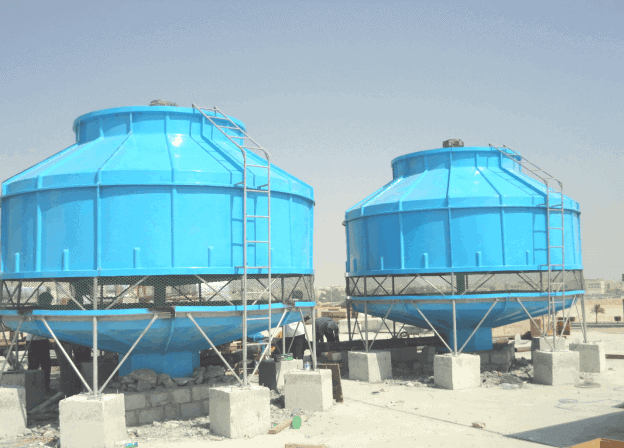
When it comes to choosing the right cooling tower for your plant, one question often stands out: Should you go with an FRP cooling tower or an RCC cooling tower?
It’s not just a technical decision. It directly impacts your operational cost, maintenance effort, efficiency, and long-term reliability. If you’re planning a new installation or considering an upgrade, understanding the difference between these two can help you make a smarter investment.
Let’s break it down in a way that actually helps you decide.
Understanding FRP and RCC Cooling Towers
FRP (Fibreglass Reinforced Plastic) cooling towers are modern, factory-engineered systems known for their lightweight structure, corrosion resistance, and easy installation. They are widely used across industries that need efficiency without complexity.
On the other hand, RCC (Reinforced Cement Concrete) cooling towers are large, site-constructed structures designed for heavy-duty operations and high-capacity cooling requirements, typically seen in power plants and large industrial facilities.
Durability: Built for Conditions That Matter
Durability isn’t just about strength—it’s about how well a cooling tower performs over time in real working conditions.
FRP cooling towers are highly resistant to corrosion, chemicals, and harsh weather. Whether your plant operates in a humid, coastal, or chemically aggressive environment, FRP structures maintain their integrity without rusting or degrading. This makes them a reliable long-term solution for most industries.
RCC cooling towers, while structurally strong, are more vulnerable to environmental stress over time. Exposure to temperature fluctuations, water, and chemicals can lead to cracks, seepage, and surface damage if not properly maintained. They often require protective coatings and periodic repairs to sustain performance.
If your operations involve challenging environments, FRP cooling towers offer a clear durability advantage with fewer long-term concerns.
Cost: Looking Beyond the Initial Investment
At first glance, RCC cooling towers may seem like a solid, long-term investment—but the real picture becomes clearer when you consider total cost.
FRP cooling towers come with a lower initial cost and significantly reduced installation time. Since they are factory-built, they require minimal civil work and can be deployed quickly, helping you save on both time and labour.
RCC cooling towers, however, involve extensive on-site construction, higher material costs, and longer project timelines. This not only increases upfront expenses but can also delay operations.
Over time, FRP cooling towers continue to deliver savings through lower repair and maintenance costs, making them a more cost-efficient choice overall.
Maintenance: Minimizing Downtime, Maximizing Efficiency
Maintenance is where the difference becomes even more noticeable.
FRP cooling towers are designed for convenience. They require minimal upkeep, are easy to clean, and don’t suffer from corrosion-related issues. This means fewer interruptions and more consistent performance.
RCC cooling towers, in contrast, demand regular inspections and ongoing maintenance. Cracks, leakage, and structural wear need attention, which can lead to higher downtime and operational disruptions.
For industries aiming to reduce maintenance burden and improve uptime, FRP cooling towers provide a much smoother experience.
Performance: Consistency You Can Rely On
Performance is not just about capacity—it’s about delivering consistent results every day.
FRP cooling towers are precision-engineered to ensure optimal airflow and efficient heat transfer. Because they are manufactured under controlled conditions, their performance is more predictable and reliable.
RCC cooling towers depend heavily on construction quality and design execution, which can vary from project to project. This may affect efficiency over time if not properly managed.
If consistency and energy efficiency are your priorities, FRP systems are designed to meet modern industrial expectations.
Choosing What’s Right for Your Industry
The choice between FRP and RCC ultimately depends on your scale and requirements.
If you’re running a medium to large industrial operation and want a solution that is cost-effective, easy to maintain, and quick to install, FRP cooling towers are an excellent fit. They are especially suitable for industries like chemicals, pharmaceuticals, HVAC, food processing, and commercial facilities.
RCC cooling towers are more suited for very large-scale operations such as power plants or heavy manufacturing units where extremely high capacity is required and space is not a constraint.
Final Thoughts: Making a Smart Investment
In today’s fast-paced industrial environment, businesses are moving towards solutions that offer efficiency, flexibility, and long-term savings. This is exactly why FRP cooling towers are becoming the preferred choice across industries. They not only reduce your upfront and operational costs but also simplify maintenance and improve performance reliability. If you’re planning your next cooling tower installation or upgrade, choosing the right material can make a significant difference—not just today, but for years to come.