

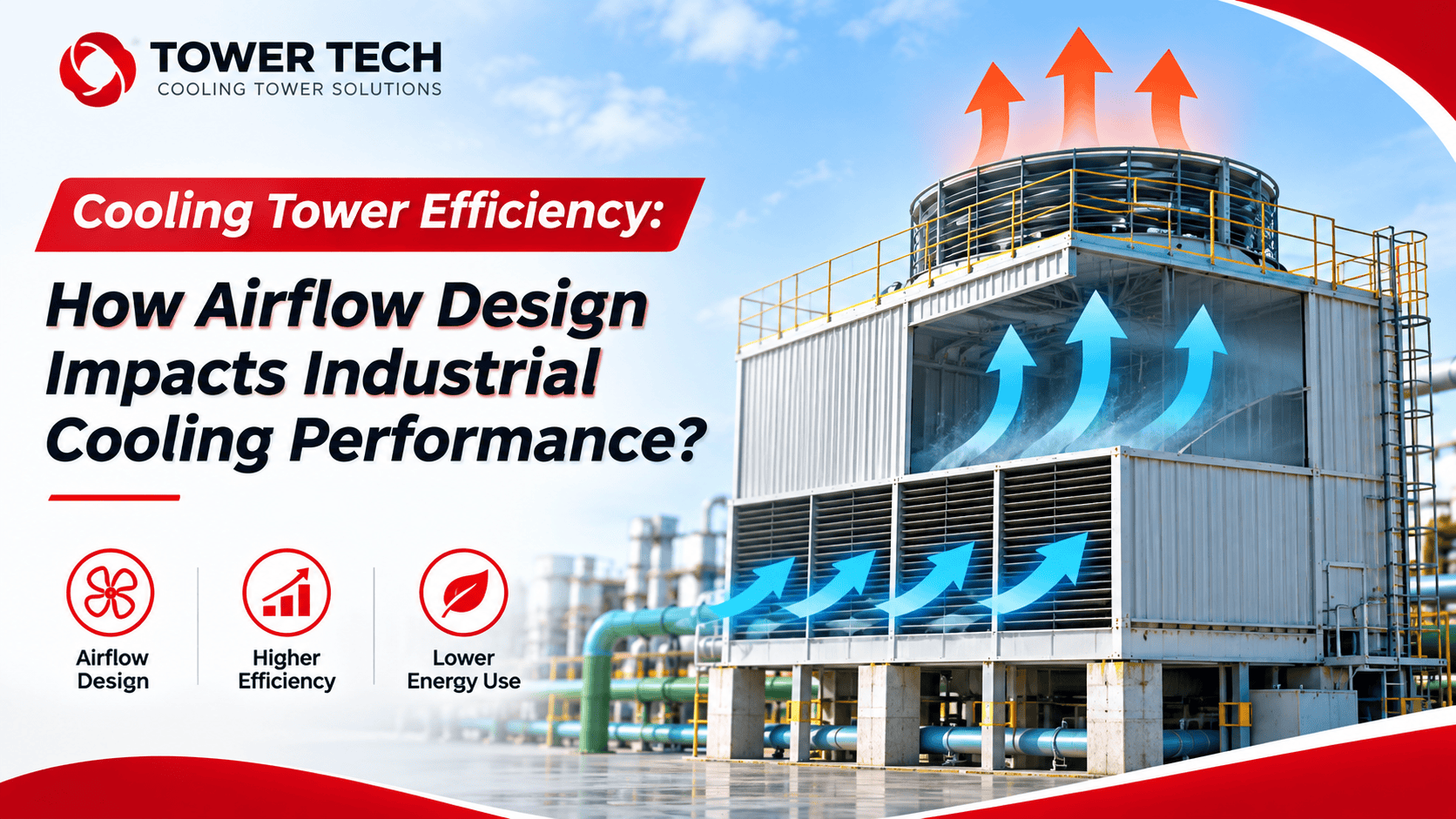
Cooling tower efficiency plays an important role in industrial operations, affecting heat rejection, energy consumption, and overall system performance. While water flow and temperature are important, airflow design is another key factor that determines how effectively a cooling tower removes heat.
Understanding airflow patterns can help plant managers, engineers, and facility operators make informed decisions when selecting or upgrading an industrial cooling tower.
How Does Airflow Affect Cooling Tower Efficiency?
Cooling towers transfer heat from circulating water to the surrounding air. In evaporative cooling towers, a portion of the water evaporates, carrying heat away from the remaining water.
For effective cooling, air must move through the tower and come into sufficient contact with the falling water. Poor airflow distribution, excessive air resistance, or warm discharge air recirculating into the tower can reduce performance.
The goal is simple: achieve effective air-water contact while managing fan power and operating costs.
3 Cooling Tower Airflow Designs to Understand
Induced Draft Cooling Towers
In an induced draft cooling tower, a fan near the air outlet pulls air through the tower and discharges warm, moisture-laden air. This arrangement supports controlled airflow through the cooling section and can help reduce discharge-air recirculation when properly designed.
Explore: Induced Draft Cooling Towers
Forced Draft Cooling Towers
Forced draft cooling towers use a fan at the air inlet to push air through the tower. Their performance depends on fan selection, airflow distribution, and the resistance created by internal components.
Counterflow and Crossflow Designs
Counterflow towers move air upward against downward-flowing water, while crossflow towers move air horizontally across falling water. These describe the relative direction of air and water—not necessarily how airflow is generated. Either arrangement must be evaluated according to the application.
What Factors Influence Cooling Tower Performance?
Airflow design is only one part of the equation. Consider these important factors:
- Fan efficiency: Efficient fans and correctly selected motors help manage electricity consumption.
- Fill condition: Clean, properly maintained fill supports effective heat and mass transfer.
- Water distribution: Uniform water flow helps prevent uneven cooling and dry areas.
- Drift eliminators: Properly functioning eliminators reduce water droplets escaping with exhaust air.
- Ambient conditions: Wet-bulb temperature influences the achievable cooling-water temperature.
- Maintenance: Fouling, damaged components, and airflow obstructions can reduce performance.
How Can You Improve Cooling Tower Efficiency?
Start by checking whether the tower consistently achieves its required cold-water temperature and cooling range. Inspect fans, motors, fill, nozzles, and drift eliminators, and monitor water flow and power consumption.
Also check for obstructions around air inlets and signs of hot, humid discharge air returning to the intake. Compare operating data under similar ambient conditions before concluding that performance has improved or declined.
Choose the Right Airflow Design for Your Plant
The best cooling tower configuration depends on heat load, water flow, operating temperatures, available space, energy requirements, and environmental conditions. A design that works well in one facility may not suit another.
Looking to improve industrial cooling performance? Explore TowerTech India’s cooling tower solutions to find a configuration that fits your operational requirements.