

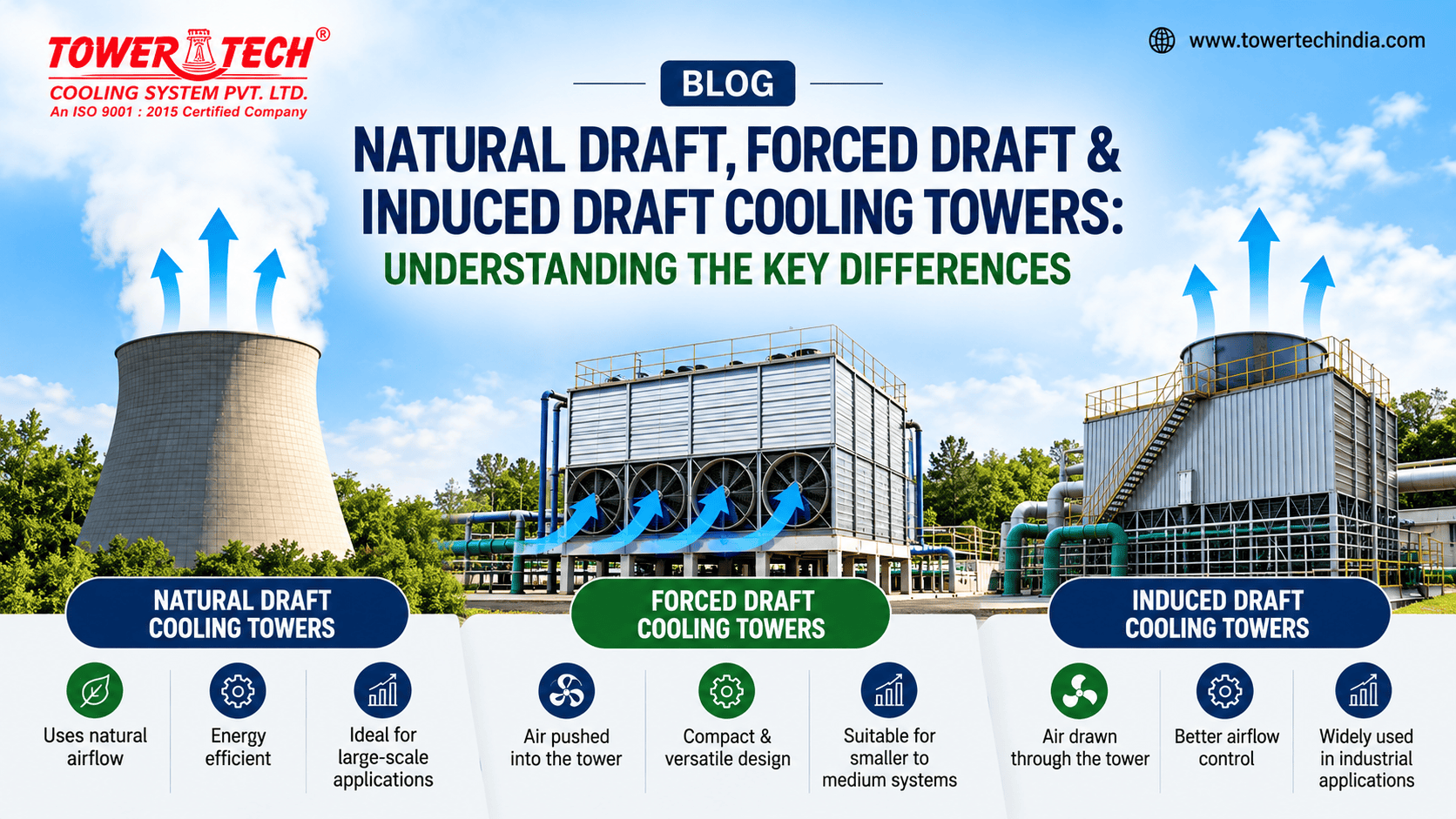
Cooling towers play an important role in removing excess heat from industrial processes, HVAC systems, power plants, manufacturing facilities, and other applications. However, cooling towers are not all designed to move air in the same way.
Natural draft, forced draft, and induced draft cooling towers use different airflow mechanisms, which can influence cooling performance, energy consumption, maintenance, space requirements, and application suitability.
Understanding these differences can help plant owners, engineers, consultants, and procurement teams identify the cooling tower configuration that best matches their operating requirements.
What Is Draft in a Cooling Tower?
In a cooling tower, draft refers to the method used to move air through the tower.
As warm process water enters the tower, it comes into contact with air. Heat is transferred from the water to the air, causing a portion of the water to evaporate and reducing the temperature of the remaining water.
The three common draft arrangements are:
- Natural Draft: Air movement is created naturally by the difference in air density.
- Forced Draft: A fan pushes air into the cooling tower.
- Induced Draft: A fan pulls air through the cooling tower and discharges it from the top.
While the basic purpose remains the same, the airflow arrangement creates important differences in tower design and operation.
Natural Draft Cooling Tower
A natural draft cooling tower does not require mechanical fans to move air. Instead, it uses the natural movement of air created by the difference in temperature and density between the warm air inside the tower and the surrounding atmosphere.
As warm, moist air rises through the tower, cooler ambient air enters through the lower sections. This continuous movement allows the cooling process to take place without fan-driven airflow.
Key Features
- No mechanical fan for airflow
- Uses natural air circulation
- Large tower structure
- Suitable for high-capacity cooling requirements
- Lower dependence on fan and motor systems
Where Are Natural Draft Cooling Towers Used?
Natural draft cooling towers are generally associated with large-scale industrial and power-generation applications, where substantial quantities of circulating water need to be cooled continuously.
Their large structural requirements mean that site availability and project design are important considerations.
Forced Draft Cooling Tower
A forced draft cooling tower uses a mechanical fan to push air into the tower.
The fan is generally positioned at the air inlet, creating positive pressure that forces air through the cooling tower. As the air passes through the tower, it comes into contact with the circulating water and helps transfer heat away from it.
Key Features
- Fan-driven airflow
- Fan positioned at the air inlet
- Compact mechanical configuration
- Suitable for various industrial cooling applications
- Requires maintenance of fans and motors
What Should You Consider?
Forced draft systems can be useful where mechanical control of airflow is required. However, fan selection, motor efficiency, airflow requirements, and maintenance access should all be considered during system design.
Induced Draft Cooling Tower
In an induced draft cooling tower, the fan is positioned at or near the air discharge section and draws air through the tower.
Instead of pushing air into the tower, the fan creates a negative pressure that pulls ambient air through the fill and water distribution area before discharging warm, moisture-laden air.
This arrangement is widely used for industrial cooling because it allows controlled movement of air through the tower.
Key Features
- Fan draws air through the tower
- Fan generally located at the top/discharge section
- Controlled airflow
- Suitable for industrial process cooling
- Available in different configurations and capacities
Why Is Induced Draft Important?
The position of the fan allows the tower to draw air through the entire cooling section before discharging the warm air. Proper tower design also helps manage the interaction between incoming and discharged air.
Natural Draft vs Forced Draft vs Induced Draft
The easiest way to understand the difference is to look at how each system moves air.
| Cooling Tower Type | How Air Moves | Fan | Typical Consideration |
| Natural Draft | Natural buoyancy | No mechanical fan | Large-scale cooling and site requirements |
| Forced Draft | Fan pushes air into tower | Yes | Controlled mechanical airflow |
| Induced Draft | Fan pulls air through tower | Yes | Controlled airflow and industrial applications |
The difference is not simply about whether a fan is present. Fan location, airflow pattern, tower configuration, operating conditions, and application requirements all influence the final design.
How Do You Choose Between the Three?
There is no single cooling tower configuration suitable for every plant. Selection should begin with the actual cooling requirements of the application.
Consider the following:
- Cooling Capacity- Determine the amount of heat that must be rejected and the required cooling water flow rate.
- Operating Temperatures- Hot-water temperature, required cold-water temperature, range, and approach influence tower selection and performance.
- Ambient Conditions- Local temperature, humidity, and especially wet-bulb temperature should be considered when designing an evaporative cooling system.
- Available Space- Natural draft towers can require substantial structural height and space, while mechanical-draft designs offer different layout possibilities.
- Energy Consumption- Forced and induced draft systems require fan power, making fan efficiency and operating conditions important considerations.
- Maintenance Requirements- Mechanical components such as fans, motors, gearboxes, and drives need regular inspection and maintenance.
- Application- The cooling requirements of a power plant, manufacturing facility, HVAC system, chemical plant, or process industry can differ significantly.
Natural Draft, Forced Draft or Induced Draft: What Should You Evaluate?
Rather than selecting a cooling tower based only on the type of draft, evaluate the complete operating requirement.
Before finalizing a cooling tower, determine:
- Required water flow rate
How much water needs to be circulated through the system? - Cooling range
What is the required temperature reduction between hot and cold water? - Approach
How close does the required cold-water temperature need to be to the ambient wet-bulb temperature? - Heat load
How much heat must the cooling tower reject? - Site conditions
What space, height, airflow clearance, and environmental conditions are available? - Operating requirements
What are the expected operating hours, maintenance conditions, and energy constraints?
These parameters provide a much better basis for cooling tower selection than comparing tower types in isolation.
Cooling Tower Selection: A Practical Approach
For plant owners and engineers, the selection process should focus on the complete cooling requirement, rather than choosing a tower simply because one design is more familiar.
A suitable cooling tower should provide the required cooling performance while fitting the plant’s:
Heat Load → Water Flow → Temperature Requirements → Ambient Conditions → Space → Energy Requirements → Maintenance Plan
Once you establish these parameters, you can evaluate the appropriate draft and airflow configuration.
Get the Right Cooling Tower for Your Application
Natural draft, forced draft, and induced draft cooling towers each use a different approach to moving air and supporting the heat rejection process.
The right configuration depends on factors such as cooling capacity, operating temperatures, water flow, ambient conditions, available space, energy requirements, and the specific industrial application.
TowerTech India provides cooling tower solutions designed for different industrial cooling requirements. Explore the relevant cooling tower options or speak with the technical team to determine a suitable configuration for your application.