

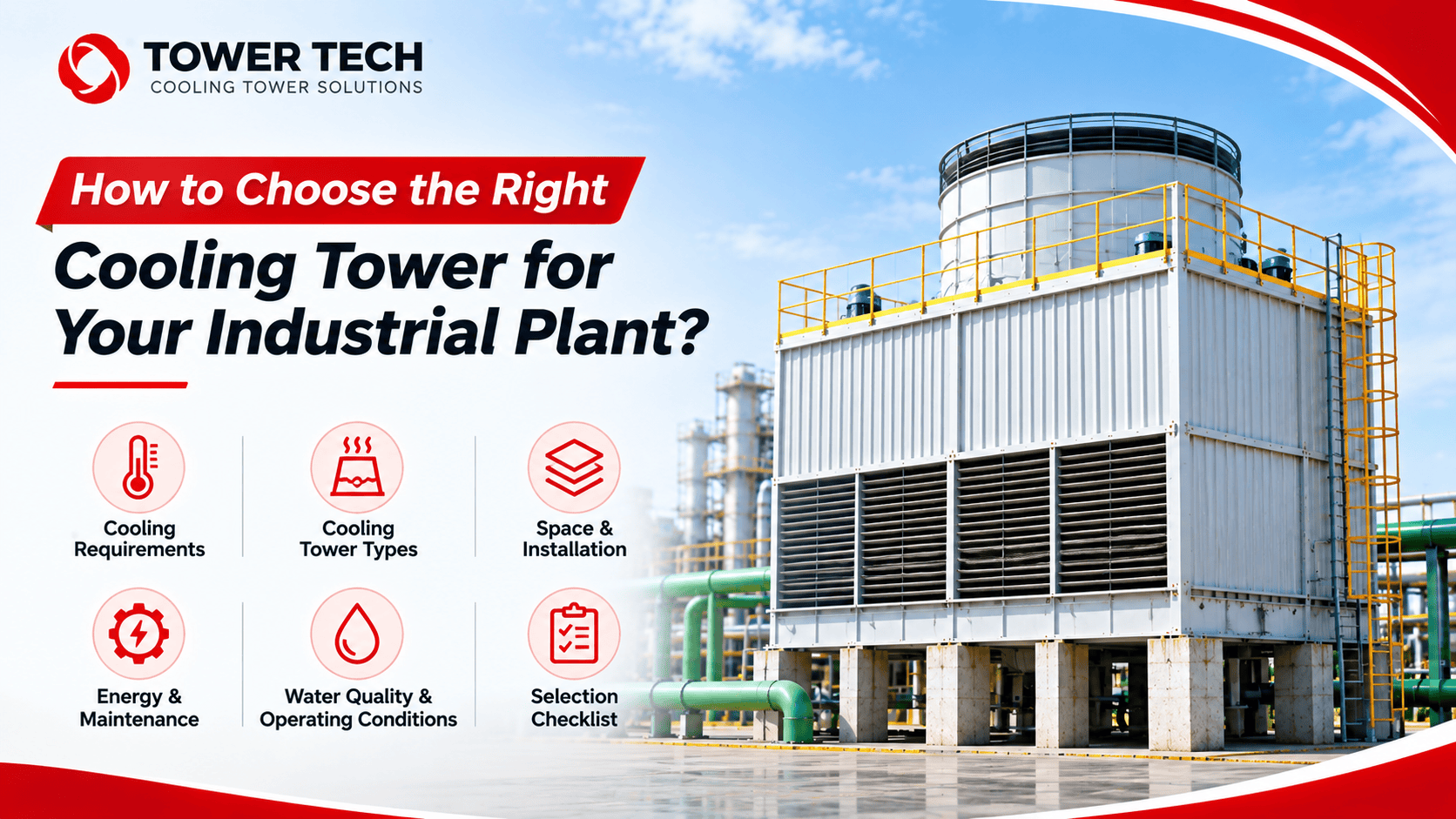
Selecting the right industrial cooling tower is essential for maintaining process temperatures, supporting reliable operations, and managing energy and water consumption. With different cooling tower designs and capacities available, the right choice depends on your plant’s specific cooling requirements—not just the purchase price.
Use this practical guide to identify the factors that matter before investing in a new cooling tower.
Calculate Your Cooling Requirements
Start by determining how much heat your process needs to reject. The required water flow rate, hot-water temperature, and target cold-water temperature are essential inputs.
Two parameters are particularly important:
- Cooling range: The difference between hot-water inlet and cold-water outlet temperatures.
- Approach: The difference between the cold-water outlet temperature and the ambient wet-bulb temperature.
These values help engineers evaluate the cooling tower’s required thermal performance.
Understand the Different Cooling Tower Types
The airflow mechanism and air-water arrangement influence the tower’s design and suitability.
- Natural draft cooling towers: Use natural air movement and are commonly associated with large-scale cooling applications.
- Forced draft cooling towers: Use an inlet fan to push air through the tower.
- Induced draft cooling towers: Use a fan near the outlet to draw air through the tower.
- Counterflow cooling towers: Move air upward against downward-flowing water.
- Crossflow cooling towers: Move air horizontally across falling water.
Remember that draft type and airflow arrangement are different classifications. For example, an induced draft cooling tower can also use a counterflow design.
Evaluate Space and Installation Conditions
Available space, structural requirements, maintenance access, and surrounding buildings can influence your choice. Consider air inlet clearance and the possibility of warm, humid discharge air recirculating into the tower.
For an existing facility, installation constraints may be just as important as cooling capacity.
Compare Energy and Maintenance Costs
The initial purchase price is only one part of the total cost of ownership. Evaluate fan and motor power, water consumption, treatment requirements, spare parts, and routine maintenance.
A properly selected cooling tower can help control operating expenses, but actual savings depend on the equipment, operating conditions, and maintenance practices.
Check Water Quality and Operating Conditions
Water quality affects scaling, corrosion, fouling, and biological growth. Your selection should account for the raw water characteristics, treatment programme, expected operating hours, ambient conditions, and process requirements.
Quick Checklist Before Selecting a Cooling Tower
Before requesting a quotation, confirm that you have:
- Required cooling capacity and water flow rate
- Hot-water and target cold-water temperatures
- Site wet-bulb temperature
- Available installation space
- Energy and maintenance priorities
- Water quality and treatment requirements
Providing these details helps manufacturers recommend a suitable configuration and evaluate performance against your operating needs.
Find the Right Cooling Tower for Your Application
The right industrial cooling tower balances thermal performance, installation requirements, energy consumption, and long-term maintenance. Working with an experienced manufacturer can help you assess these factors before finalizing the design.
Planning a new installation or upgrading an existing system? Visit TowerTech India to explore cooling tower options for your industrial plant.