

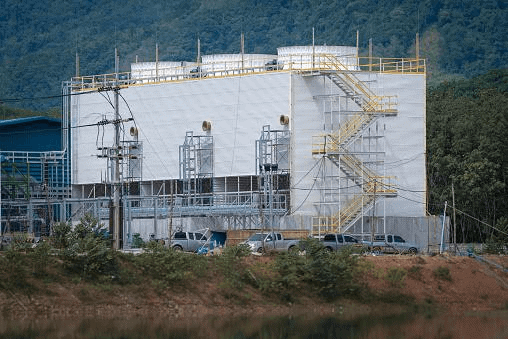
If you have researched a new cooling tower in recent years, FRP has undoubtedly come up on your radar. It is specified by engineers, recommended by suppliers and plant managers who have made the transition to continue to use it instead of other materials.
So what’s actually going on? Is this genuinely a better product, or just effective marketing?
The brief response explains how pultruded FRP cooling towers provide actual engineering benefits which surpass the capabilities of older materials because understanding this relationship reveals the complete nature of the trend.
What Is a Pultruded FRP Cooling Tower?
Let’s start with the basics.
FRP refers to Fibre Reinforced Plastic which constitutes a composite material created through the combination of glass fibres and polymer resin. The material exhibits strength and lightness which results in chemical resistance that exceeds the protective abilities of metals and concrete.
The word “pultruded” refers to the specific technique which manufacturers use to produce their products. The pultrusion process creates structural profiles which maintain uniform cross-sectional dimensions while achieving maximum strength through the technique of drawing continuous glass fibre strands through a resin bath followed by passage through an industrial heated die system.
The outcome is FRP cooling tower components, structural columns, crossbeams, grating, casing panels, that are manufactured to precise specifications, arrive at site ready to assemble, and deliver mechanical performance that holds up under continuous industrial operating conditions.
A pultruded FRP cooling tower combines this material with a design optimised for heat exchange, fill media, drift eliminators, distribution systems, and fan assemblies, all housed in a structure that’s built to last in environments where steel would corrode and concrete would crack.
Why FRP Cooling Towers Are Better Than Metal?
Steel cooling towers experience corrosion because this process will occur at some point in time. The constant flow of treated water from industrial facilities that contain dissolved minerals, treatment chemicals and biological agents causes metal surfaces to experience continuous deterioration until they completely fail. The expenses for maintenance continue to increase while the building structure starts to weaken which results in the need for replacement before its expected date.
Corrosion resistant cooling towers built from FRP avoid this problem fundamentally. Here’s why they outperform metal:
- Glass fibres don’t rust, chemically inert against the aggressive environments that destroy steel
- Polymer resin matrix resists the chemical attack common in plants handling acids, alkalis, and treatment chemicals
- FRP structures can outlast equivalent steel structures by 15-20 years in corrosive industrial environments
- Pultruded FRP is 60-70% lighter than steel or RCC equivalents, reducing foundation requirements and making rooftop installation practical
- No repainting, no rust treatment, no corrosion-related structural repairs over the operating life
FRP Cooling Tower vs RCC Cooling Tower
| Basis | FRP Cooling Tower | RCC Cooling Tower |
| Construction time | Fast — prefabricated, site assembly | Slow — extensive civil work required |
| Weight | Lightweight | Very heavy |
| Corrosion resistance | Excellent | Moderate (internal components still corrode) |
| Flexibility | Modular, relocatable, expandable | Fixed, permanent structure |
| Foundation requirement | Minimal | Heavy civil engineering needed |
| Maintenance access | Easy | Can be difficult internally |
| Best suited for | Most industrial applications | Very large scale installations |
| Cost over lifetime | Lower (less maintenance) | Higher (ongoing repairs) |
For most new installations and replacement projects across Indian industry in 2026, the comparison increasingly favours fiberglass cooling towers, except in the very largest scale applications where RCC remains the engineering choice.
Benefits of Pultruded FRP Cooling Towers in Industry
The FRP cooling tower advantages stack up across multiple dimensions:
Corrosion resistance is the main advantage of the material, which lies in its ability to serve as the primary reason customers choose to switch to it. Industries that work with acids or alkalis or saline water or high-strength treatment chemicals find that FRP material remains intact while metal components break down.
Structural consistency from the pultrusion process means every component meets the same specification. There’s no variation in wall thickness, no weak points from welding or joining, no uncertainty about whether a particular member was manufactured correctly.
Lower installation cost and time compared to site-built alternatives. Pultruded FRP components are manufactured offsite, quality-controlled in the factory, and assembled on site with minimal specialist labour. A project that might take weeks with concrete or complex steel fabrication can be completed in days.
Reduced maintenance expenditure over the operating life. The facilities that operate multiple cooling towers will achieve significant savings because they will experience fewer corrosion-related repairs and require no repainting and need less frequent major maintenance work.
Electrical non-conductivity is relevant in certain industrial contexts where earth leakage or stray current is a concern. FRP does not conduct electricity which provides the advantage of removing one specific danger that metal structures present.
Where Pultruded FRP Cooling Towers Are Being Specified
In 2026 Indian industries will use pultruded FRP cooling tower systems to meet their various operational requirements.
- Chemical and petrochemical plants – where process streams and treatment chemicals create the most aggressive corrosion environments. This is arguably where the performance advantage of FRP cooling towers over metal is most pronounced and most financially significant.
- Pharmaceutical companies need to maintain hygienic conditions, protect their facilities against chemicals, and use materials that do not corrode to ensure their products meet quality standards and official regulations.
- The operational effectiveness of power generation facilities depends on their cooling towers because unplanned downtime creates high expenses which make facilities need to maintain their structural reliability.
- Food and beverage processing facilities have used stainless steel as their standard material because it ensures hygienic conditions yet FRP provides equal hygiene protection at reduced costs and weight.
- Fertiliser and agrochemical production – industries where ammonia, acids, and other aggressive chemicals make conventional metal structures a persistent maintenance headache.
For facilities evaluating cooling tower options across these sectors, the material selection decision has become one of the most consequential choices in the specification process.
Why Is This Trending in 2026 Specifically?
Three things have converged to accelerate FRP cooling tower adoption in India right now.
The fluctuating steel prices since 2021 have created conditions that allow FRP to compete with traditional materials at lower manufacturing costs. Indian FRP cooling tower manufacturers are now producing pultruded components that reliably meet international quality specifications. And accumulated field experience means engineers and plant managers who’ve seen FRP perform in one application are confidently specifying it for the next.
The Indian industrial cooling market is projected to experience annual growth exceeding 6% until 2028 while companies are installing FRP materials to build their new capacity.
Choosing the Right FRP Cooling Tower for Your Application
Not all FRP cooling towers are equivalent. The quality of the resin system, the fibre content and orientation in pultruded members, the design of the fill and distribution system, and the engineering behind the overall configuration all affect how the tower actually performs in operation.
Working with an experienced FRP cooling tower manufacturer in India means getting a specification that’s built around your actual heat load, your water quality, your site conditions, and your maintenance capability, not a catalogue product applied generically.
Towertech India designs and supplies pultruded FRP cooling towers for industrial applications across India. The process of evaluating materials for new installations and existing tower replacements that create maintenance problems should begin with a discussion about your actual operational needs.