

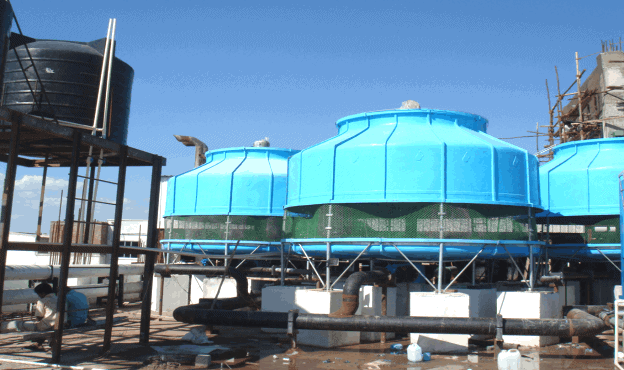
Have you ever experienced an extremely hot day during June where you have walked through a facility that feels like the cooling system can barely keep up with what is happening? Your cooling tower has broken equipment because the system cannot handle the extreme temperatures present in Indian weather conditions. The equipment in Ahmedabad and Chennai and Delhi operates in combat mode instead of normal operation.
The requirement to maintain a cooling tower in India becomes challenging because we experience multiple types of weather throughout the year. Our summer season brings us extreme dry conditions which reach 45°C before the monsoon season brings heavy rainfall with high humidity and debris. The maintenance schedule creates problems when it fails to align with seasonal changes because even minor issues such as thin scale deposits or small algae blooms can result in complete shutdown of the plant.
Effective cooling tower maintenance India isn’t just about a “once-a-year” checkup. It’s the control tower for your production efficiency. Let’s break down how to prepare your system for the two most aggressive seasons in the Indian calendar.
The Summer Struggle: Maximizing Efficiency Under Heat Stress
In an Indian summer, your cooling tower is under maximum load. High ambient temperatures mean the “approach”, the difference between the cold water temperature and the ambient wet-bulb temperature, shrinks, making every percentage point of efficiency vital.
The efficiency of summer cooling towers experiences a decline because of one hidden factor which operates silently as scaling. The higher temperatures lead to increased water evaporation which results in higher dissolved solid concentrations of calcium and magnesium. If your “blowdown” rate isn’t adjusted, these minerals bake onto your fill media like concrete.
The Summer Checklist:
- Fill Inspection: Check for scale buildup. Even a 1mm layer of scale can reduce heat transfer efficiency by over 10%.
- Fan Pitch Adjustment: Ensure your fans are pulling the maximum volume of air. A slight misalignment here means your motor is working harder for less cooling.
- Water Chemistry Audit: In summer, you need to increase the frequency of your water testing. According to the Association of Water Technologies (AWT), proper chemical dosing during high-evaporation periods can extend the life of your fill media by years.
The Monsoon Pivot: Managing Debris and Biological Growth
Just as you get a handle on the heat, the monsoon arrives. While the ambient temperature drops, the humidity spikes, and the wind carries a massive amount of dust, leaves, and organic debris into your water basin. This is where cooling tower seasonal maintenance becomes a battle against nature.
Monsoon cooling tower care is primarily about filtration and biological control. The rain brings nitrogen and organic matter into the system, which acts like “super-food” for algae and Legionella bacteria.
The Monsoon Checklist:
- Basin Cleaning: Cold-water basins receive silt from heavy rains which wash it into the waterway. The sludge will enter your heat exchangers if you do not remove it because it will create “under-deposit corrosion” problems.
- Algae Control: High humidity and organic influx lead to rapid biological growth. According to CTI (Cooling Technology Institute), uncontrolled biological growth creates “biofilms” that are far more insulating than mineral scale.
- Louver Maintenance: You must keep your drift eliminators and louvers free from all types of obstructions. The monsoon season brings wind-driven waste which obstructs the air intake and creates operational problems for the tower.
Why “Manual” Checks Often Fail in Indian Conditions
A common pattern in cooling tower maintenance India is the “reactive” approach, fixing things only when the high-temperature alarm goes off. By that time, the damage to your chillers or heat exchangers is already done.
In the Indian industrial context, the “Before” state is often a tower with clogged nozzles and a basin full of silt. The “After” state is a system that utilizes Tower Tech’s high-efficiency designs that are built to withstand these specific swings. According to Central Pollution Control Board (CPCB) guidelines, efficient water management isn’t just a cost-saving measure; it’s a regulatory requirement for Indian industries.
The Strategic Fix: A Year-Round Roadmap
To keep your plant running without a hitch, your maintenance needs to be “proactive,” not just “preventive.”
- April Prep: Before the heat hits, do a deep-clean of the fill media. This is your “efficiency insurance” for May and June.
- June Prep: Before the first rains, check your drift eliminators and secondary filtration. You want to keep the monsoon mud out of your internal piping.
- August Audit: Mid-monsoon is the time to double-check your biocides. The humidity is at its peak, and so is the risk of algae.
Research by Bureau of Energy Efficiency (BEE) India suggests that well-maintained cooling systems can reduce a factory’s total energy bill by up to 15%. In a country where energy costs are a major overhead, your cooling tower is the easiest place to find “found money.”
Final Perspective
The difference between a plant that struggles every summer and one that stays cool is often just a few hours of targeted, seasonal work. The system requires you to maintain the cooling towers because Indian cooling tower operations need to handle two different challenges which emerge during the summer and monsoon periods.
Devotion to your equipment’s health is the only way to ensure it stays devoted to your production schedule. Don’t let the Indian climate dictate your plant’s uptime.